Golden Delicious Vintage
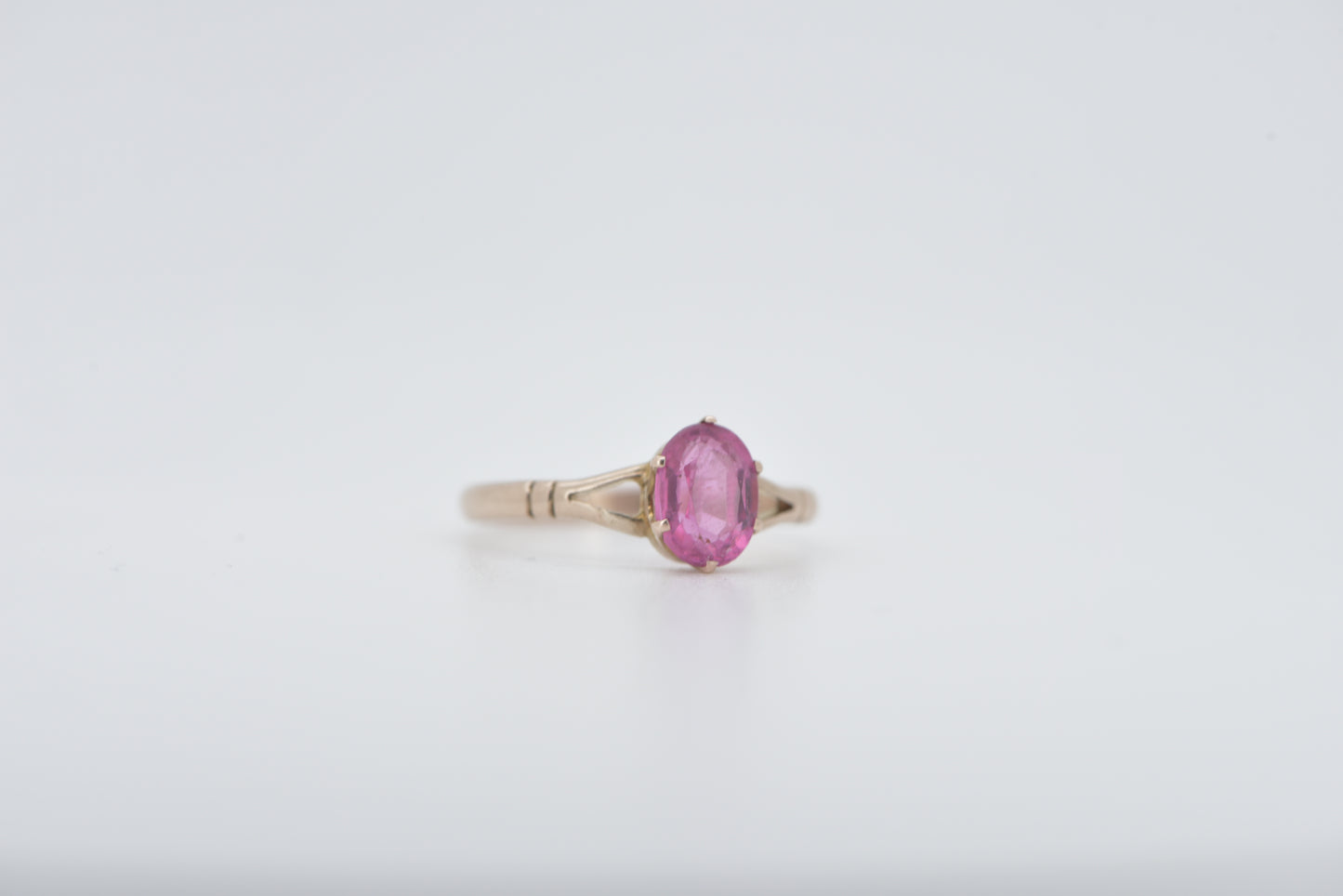
Abigail - 9ct Antique Australian candy pink stone ring
Abigail - 9ct Antique Australian candy pink stone ring
Couldn't load pickup availability
A really lovely example of an Antique Australian piece by well known Melbourne Jewellers W.J. Moore and Sons. Stamped with Antique Australian hallmarks including the 9 and wheat sheaf for 9ct gold. This is a gorgeous example of late 19th - early 20th C jewellery with elegant split shoulders and clawset crown style setting.
The stone is candy coloured and absolutely beautiful.
Size P / 7.5US
Stamp - Australian makers mark 9ct and the wheat sheaf.
1.6g
Stone - Unsure
Era - Antique Victorian
- 1887 – The Foundations: The business is established under the name Moore Bros, operating out of retail premises at 162 Elizabeth Street, Melbourne.
- 1893 – Sole Proprietorship: William John Moore takes full control of the firm as sole proprietor, pivoting the business deeply into manufacturing.
- 1911 – Trademarking the Cross: William registers his distinctive "Maltese Cross" trademark. It is used alongside the guarantee stamps of the Manufacturing Jewellers’ Association of Victoria (M.J.A.) to certify gold quality.
- 1918 to 1942 – The Heart of the City: The workshop moves into the famous laneways of Melbourne's jewelry quarter, operating from 340 Little Collins Street.
- 1923 – A New Era: The firm officially rebrands to W.J. Moore & Sons.
- 1937 – Expanding the Family Tree: The business officially registers as a proprietary limited company with a capital of £20,000, run by family members C.H. Moore, N.W. Moore, and W.J. Moore.
- 1943 – Branching Out: The family enterprise splits into two distinct entities: W.J. Moore and Sons Pty Ltd and S.N. Moore and Co. Pty Ltd.
- Present Day: The historical trademark was formally retained until 1955, but the enduring lineage of the brand continues to this day. Their modern trade and manufacturing facility still operates out of 153 Montague St, South Melbourne.
- The Maker’s Mark: Look for the signature Maltese Cross pictorial symbol.
- The Purity Number: Usually marked as "9" (9-carat) or "15" (15-carat) gold.
- The M.J.A. Guarantee Mark: Early 20th-century 15ct pieces feature a "Hanging Fleece" (or sheep) symbol—the quality guarantee used by the Manufacturing Jewellers' Association of Victoria. If it is 9ct gold, you will often find it paired with a sheaf of wheat.
History of Paste Stones in Jewellery
Antique paste stones are high-lead glass historically hand-cut and polished to imitate fine gemstones like diamonds, rubies, and sapphires. Originating in the 18th century, these dense, brilliant jewels were commonly foil-backed to enhance sparkle and were prized by both nobility and the emerging middle classes
Parisian jeweler Georges Frédéric Strass (from which the word strass is derived) popularized these stones in the 1720s
Unlike modern molded rhinestones, antique paste was crafted from flint glass with a high lead oxide content, which increased its refractive index and overall brilliance. Due to their high lead content, paste stones are noticeably heavier and denser than standard glass or modern plastics.
Because they were individually cut and polished rather than poured into a mold, authentic antique paste stones feature sharp, crisp facet edges.
Under a loupe or magnification, genuine glass paste will often reveal faint swirling patterns and tiny, perfectly round air bubbles.
Jewellers frequently placed colored or metallic foil behind the stones to reflect light, mimicking the deep, vibrant hues of natural emeralds, rubies, or sapphires
Georgian (1714–1837): Paste stones were set with the same meticulous care as real diamonds. They were frequently set in closed-back silver settings to protect the fragile foil from water and tarnishing.
Victorian (1837–1901): The style remained highly sought after, often used creatively in mourning jewelry, novelty brooches, or mimicking semi-precious gems like turquoise.
While paste itself is simply lead glass, the value lies in the antiquity of the hand-crafted metalwork (often sterling silver or gold) and the historical significance of the piece.
Shipping is $10 flat rate within Australia and New Zealand for orders up to $500. Free shipping for orders $500 and over. For overseas purchases please contact me and I will give you a quote and arrange payment.
No change of mind returns
Share